
How to Find Alabama Residents
There is no single Alabama roll that names every person at every home. A state lookup can confirm a registered voter or a court-party entry, while a county tax card connects a parcel to its titled owner. Libraries and archives hold address directories, newspapers, and older county records. Each source answers a narrower question than “who lives here,” so begin with the record that fits the name, address, or era already known.
A practical path keeps the county in view. A town name may cross a county line, and the parcel, deed, court file, or voter record follows its own custodian. Save the exact spelling, the result date, and any parcel or case number. Those details help the right office find the source record and let you compare a current entry with an older one. Treat each Alabama residents directory result as a lead, not a final answer.
- Write down the full name, known county, address variants, and the time period that matters.
- Check Alabama VoterView for a one-person registration result, or use the ALDOR directory to find the county property portal for an address or owner.
- Use the parcel number or legal description to ask the county probate office for a deed index entry.
- For an older household, search a local directory, census, newspaper, or ADAH microfilm record that covers the right year.
- Request a specific document from its custodian when an online index ends, and keep its reference number with your notes.
Alabama's Resident Records Offices
Alabama's offices divide these records by subject and by county. The state archives preserve historical local series, the health department files vital events, and the Secretary of State supports voter and state-record searches. For present property or probate records, first identify which of Alabama's 67 counties holds the address. The state county-official lookup routes a search by city, county, Board of Registrars, probate judge, or circuit clerk.
Alabama Department of Archives and History
Search county-series microfilm, maps, directories, newspapers, and digital collections through the state archive's catalog and research tools.
Alabama Center for Health Statistics
Alabama's statewide source for birth, death, marriage, and divorce certificates, with county health departments as local access points.
Alabama Secretary of State
VoterView handles one-name checks; the Secretary of State also routes county election contacts and offers separate voter-list and public-record request forms.
Alabama VoterView Search Fields
The free statewide lookup asks for a first name, last name, and date of birth. Its result can show registration status, address, polling place, ballot status, and election details. It does not show a person's ballot choice. Jefferson County users may need to pick an election in the detail control to see the selected election information.
| Field or control | What to enter | What it helps check |
|---|---|---|
| First Name | Text | Starts a one-person lookup. |
| Last Name | Text | Pairs with the given name and date field. |
| Date of Birth | Three-part date input | Helps separate people with the same name. |
| Residential location | Address input in polling-place search | Returns voting-place details, not a list of residents. |
For a broader geographic extract, the Secretary of State's voter-list request form lets the requester select a county, city, precinct, or other listed district; choose active, inactive, or both; and ask for available fields and a delivery format. The office quotes the cost first. For qualifying protected voters, public lists omit every field except the voter's name; the form's “as available” notes also matter.
Current Sources in the Alabama Residents Directory
The Alabama residents directory idea is really a set of separate public sources. An owner record is not a resident list, a voter check covers one registration, and a court docket records a party to a case. Use the type of evidence that matches the question, then confirm the entry with its custodian.
| Record source | What it can show | Custodian | Route |
|---|---|---|---|
| County parcel and tax card | Owner, parcel, situs, tax-mail address, and fields the county publishes | Revenue commissioner or tax assessor | County portal, counter, or copy request |
| VoterView or voter list | One registration result or available fields from an approved geographic list request | Secretary of State and county Board of Registrars | Free individual lookup; separate list request |
| Deed and probate records | Named parties to instruments, estates, and other filed matters | County Judge of Probate | County portal, courthouse, mail, or archives lead |
| Trial-court index | A party's case type, dates, actions, and linked filings | Alabama Unified Judicial System and circuit clerk | Remote service or free clerk-office viewing |
| Local library collections | Historical names, addresses, news, yearbooks, and community records | Public library or Alabama archives | Catalog, digital archive, microfilm, or research visit |
These lines are not a complete household count. A tax record can lead to an owner who receives mail elsewhere, and a historic directory is a dated publication rather than a live roll. For names attached to court matters, use the Alabama resident lookup workflow to compare the case with other official sources.
Alabama Parcel Cards Show Ownership
The Alabama Department of Revenue keeps a directory of county appraisal and assessment offices, with links to online property searches or map viewers where counties supply them. It is a routing page, not one statewide parcel database. Search options, fields, map layers, image access, and fees differ by county, so use the office listed for the parcel's county.
ALDOR's county office directory can lead to county-level property searches, map viewers, or office contacts. If an online search does not return a record, the revenue office may offer a public terminal or paper card; the probate counter, a focused mail request, and local library or archive holdings are other routes. Keep the situs address, the parcel's physical location, separate from the mailing address on the tax record.
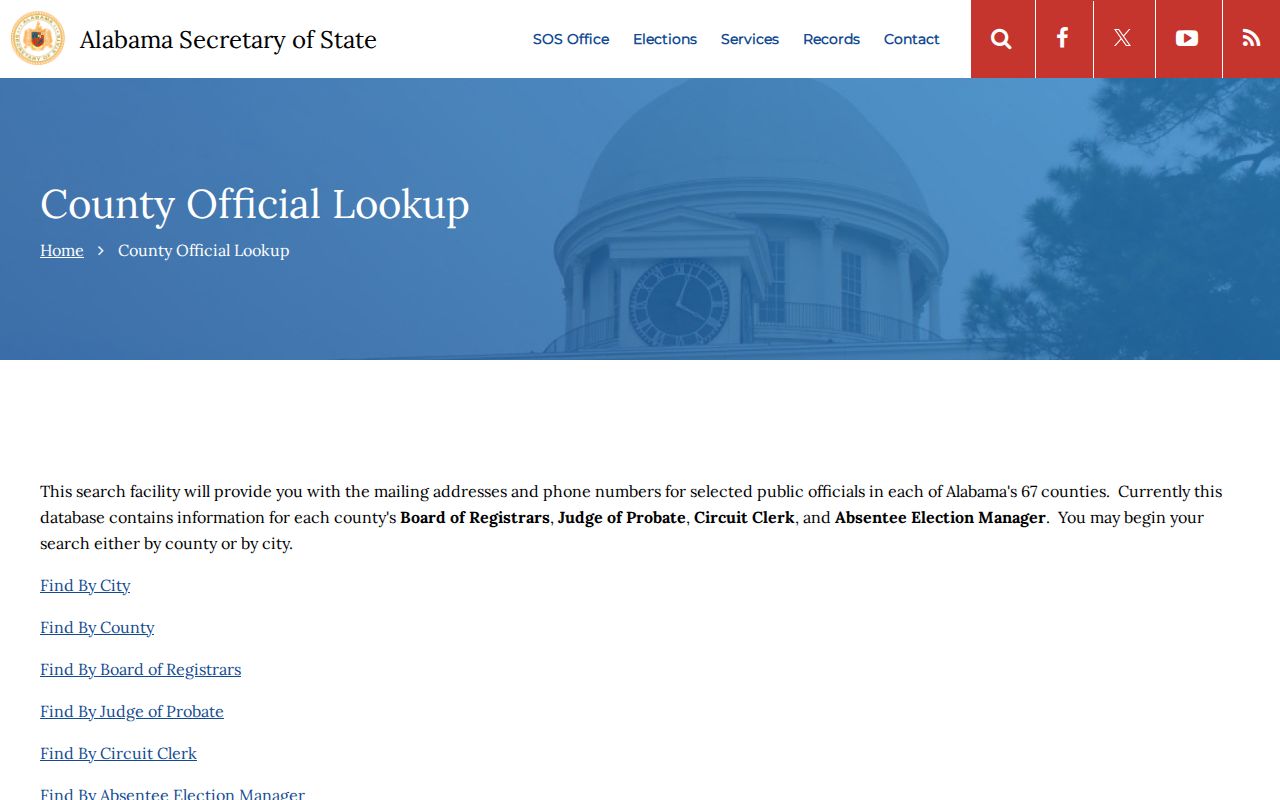
The screenshot below shows the Secretary of State's County Official Lookup, which routes readers to county probate judges, circuit clerks, Boards of Registrars, and election contacts. Use it to identify a local custodian, alongside ALDOR's property-office directory, not as a parcel search.
Once a county and parcel are clear, follow a named street parcel by parcel in the Alabama street-directory workflow; an owner field still does not establish who occupies the property.
Alabama Court Dockets Need a Name Check
The statewide trial-court portal, Just One Look, offers name and case-number searches across criminal, civil, small-claims, state-traffic, domestic-relations, and child-support matters. A report can show parties, setting dates, actions, rulings, costs, a case-action summary, and linked images. A case hit is only a lead: compare the county, names, dates, and other lawful identifiers before deciding whether it belongs to the person you mean.
A name search costs $9.99, with one case detail included; each added case detail costs another $9.99. Images cost $5 for the first 20 pages and 50 cents for each later page. Since January 1, 2025, district and circuit electronic dockets and filings can also be viewed without charge at the circuit clerk's office during regular business hours. Remote subscriber access and Just One Look are separate options.
Some filings do not appear online, and juvenile, sealed, expunged, or protected records may be absent or redacted. Municipal court cases are held by the city court clerk and are not guaranteed to appear in Alacourt. Federal matters use PACER and the federal district clerk, not Alabama's trial portal. The Just One Look portal lists current search types and prices.
Alabama Vital Records Have Time Limits
The Alabama Department of Public Health Center for Health Statistics files statewide birth and death records from 1908, marriage certificates from August 1936, and divorce certificates from 1950. These are event records, not a general list of present residents. County health departments can issue many certificates in person, mail requests generally take 7–10 days, and online or telephone orders go through VitalChek with added fees.
Access depends on the record and its age. Birth records remain restricted for 125 years, and death records for 25 years. During the restriction period, the requester must fit an authorized relationship or legal-representative category and provide valid identification. Marriage and divorce certificates are nonrestricted from the state coverage dates above; earlier marriage information belongs with the probate office that issued the license, and earlier divorce files are with the county circuit court.
The standard first search and copy fee in the research is $15, with $6 for each additional copy on the same order. A failed search may still carry the search fee. The vital-records bureau card above links ADPH's HS-14 form, identification rules, and local health department access.
ADAH's 1867 Alabama Voter Books
One of Alabama's most striking historical resident sources is not a city directory. The Alabama Department of Archives and History holds 1867 voter registration books, a major record of African American men living in the state after the Second Reconstruction Act. These books can help family historians find a name in a county and time period, then move to land, court, church, newspaper, or census records for more context.
The books are not a full list of every resident. Their purpose and eligibility rules were tied to the Reconstruction-era registration process. Treat an entry as a dated historical record, retain the county and book details, and compare it with the next source. ADAH's research guidance also points to county reference books, microfilmed deeds and wills, newspapers, maps, church records, and military collections.
Alabama Archives Fill the County Gap
The state archive's county-records microfilm search lets a reader select a county and one record type, such as deed or will. ADAH says every county is represented; the earliest series in some places predate statehood, while the latest microfilm is generally from the 1950s. Many original books remain with the county office, so the microfilm database helps locate a series but does not replace the custodian.
Researchers can search ADAH's online catalog and digital collections, visit the Research Room, or use its written research request service. The request permits up to four sources and 20 pages for one surname; the stated rates are $15 for Alabama residents and $25 for out-of-state residents, with a typical two-to-three-week response. A local library, archive, or courthouse counter may be better for a narrow question or a book held nearby.
The Secretary of State's public-records policy links its request form. Alabama's Open Records Law, Ala. Code §36-12-40, allows citizens to inspect and copy public writings unless another law creates an exception. Executive Order 734 sets response and fee procedures for executive-branch requests. Those standards do not automatically govern counties, cities, or courts, which have their own custodians and access rules. Name the office, record type, time span, and delivery choice instead of asking one broad statewide request to search everywhere.
The Secretary of State's Lands search offers statewide historical records from statehood through 1950 using name, township/range/section, and book modes. Later deed records generally start with the county probate office.
Older Volumes in the Alabama Residents Directory
Alabama has no single statewide city-directory run. Mobile Public Libraries holds local directories going back to 1837; Birmingham Public Library's Southern History Department begins its Birmingham run in 1883; and ADAH's Montgomery finding aid documents volumes from 1897 through 1957, with gaps. These collections are local snapshots, not a full account of every household in the state.
A printed book may include an alphabetical resident list, a street guide, a suburb section, or business pages. Reverse directories can start from an address; a name-first entry may add an occupation or household clue. Editions can skip years or cover a larger metropolitan area than the city named on the cover. Alabama residents directory holdings differ by library and city; the Alabama city directory collections page details the local shelves and ways to compare editions.
Alabama ZIP and County Lines Differ
Alabama covers 67 counties, and postal names do not map neatly to city limits or county lines. USPS assigns a delivery ZIP to an address; the Census Bureau's ZCTA is a statistical area built from ZIP geography, not a live delivery boundary. A PO Box-only or unique ZIP may not describe a residential neighborhood at all.
Use the Census Bureau's 2026 Gazetteer and ZIP-to-county and ZIP-to-place relationship files for statewide comparisons, then check a particular street address with USPS. The county is still the key for property, probate, court, and local government records. A mailing city can differ from the incorporated place, and a ZIP can cross a county boundary. For a tax question, keep both the physical parcel address and tax-mail address in your notes.
Note: Census ZCTAs describe statistical geography, while USPS remains the source for delivery-point ZIP verification.
Alabama Records Protect Some Details
Public does not mean every field is open. Alabama law exempts library registration and circulation records, and motor-vehicle details have separate federal limits. Vital-record restrictions depend on the event and date. Court rules protect personal identifiers and allow some filings to be sealed or redacted. Alabama has no general substitute-address program in the official sources reviewed, but specified voters can affirm protected status so public lists omit their address and other details.
VoterView is for a one-person check; a bulk list uses its own request process and may provide only fields available for the chosen geography. A record may be stale, incomplete, or about a different person with the same name. Ask the custodian how to correct a voter or parcel record, how to request court redaction, or whether a library item is restricted before sharing information from it.
| Source type | Useful for | Limit to keep in mind |
|---|---|---|
| Official rolls and files | Confirming a dated filing or record with its custodian | Coverage and protected fields depend on the law and office. |
| Commercial profile service | May collect leads from public and purchased data | May merge people, show stale details, or lack clear source dates. |
- Roll
- A list kept for a specific public purpose, such as voter registration.
- Index
- A finding aid that points to a record; it may not include the full document.
- Parcel
- A mapped unit of land used in assessment and deed records.
- Situs address
- The physical location of a parcel, which may differ from its tax mailing address.
Alabama Voter Lists Carry New Dates
Alabama's 2026 voter-information material reflects Act 2025-424, which replaced ERIC with the Alabama Voter Integrity Database, or AVID, for voter-list maintenance. The Secretary of State says AVID uses information from ALEA, USPS National Change of Address, federal Social Security death records, and interstate agreements. The Secretary of State's AVID update explains that change for readers comparing an older printed list with a current lookup.
Registration status can change when a voter updates an address, when list maintenance finds a move or death, or when confirmation mail is returned. “Active,” “inactive,” or “cancelled” status alone does not prove where someone is physically present. To correct a record, contact the county Board of Registrars through the official routing directory and ask which form or evidence it needs.
Note: Keep the date of a voter result with your record number, because a later list may reflect maintenance or a voter update.