
Alabama Directory Collections
Alabama has no single statewide directory run. A local library may hold a long shelf for its own town, while the state archives describe other runs and gaps through finding aids. R.L. Polk titles appear in broader urban holdings, alongside older local publishers, telephone companies, chambers, and commercial directories. Coverage varies, and a title can shift from city to suburban or telephone directories. Use the exact edition and holding institution before treating a blank year as a break in a household's history.
| Collection | Years held | Where held | Access |
|---|---|---|---|
| Mobile directories and phonebooks | From 1837; also selected neighboring communities | Mobile Public Libraries Local History & Genealogy | Library visit; local digital collections also online |
| Birmingham directory volumes | Birmingham Public Library begins 1883, with gaps in 1933, 1936, 1943, and 1945; Alabama Department of Archives and History (ADAH) holds Birmingham volumes from 1980-July 2007 and suburban samples from 1975-1996 | Birmingham Public Library Southern History; ADAH LPR104 | Library, microfilm, or ADAH finding aid |
| Montgomery printed volumes | 1897-1957 documented, with gaps and duplicate copies | ADAH LPR104, boxes 103-124 | Finding aid, catalog, and Research Room |
| Alabama local and telephone directories | National Archives circa-1930 examples: Anniston 1926, 1929, 1931; Birmingham 1929-1932; Mobile 1928-1932; Montgomery 1928-1929, 1931, 1933; Selma 1922, 1924, 1926, 1929-1931; Tuscaloosa 1913-1917, 1922-1925, 1929-1932 | National Archives microfilm; Library of Congress directory guide | Check individual catalog and local access |
This table is a set of documented examples, not a complete statewide inventory. ADAH's LPR104 finding aid lists local titles and years, while a catalog entry may point to a box, microfilm, or onsite material rather than a scanned book. A library may also keep editions that do not appear in the state finding aid.
Mobile Directory Shelves in Alabama
Mobile Public Libraries' Local History & Genealogy Library is at 753 Government Street in Mobile. It is open Monday through Saturday, 9 a.m. to 5 p.m.; staff can be reached at (251) 494-2190 or mainlhg@mplonline.org. Its directory holdings include Mobile volumes from 1837 and editions for Prichard, Polk County, Fairhope, and Daphne. The room also has newspaper microfilm, yearbooks, church and county records, vertical files, obituaries, and Ancestry Library Edition for use in the library.
The Mobile Local History & Genealogy page lists its hours, services, and collection areas. Check its current details before planning a visit or asking staff to look for an edition.
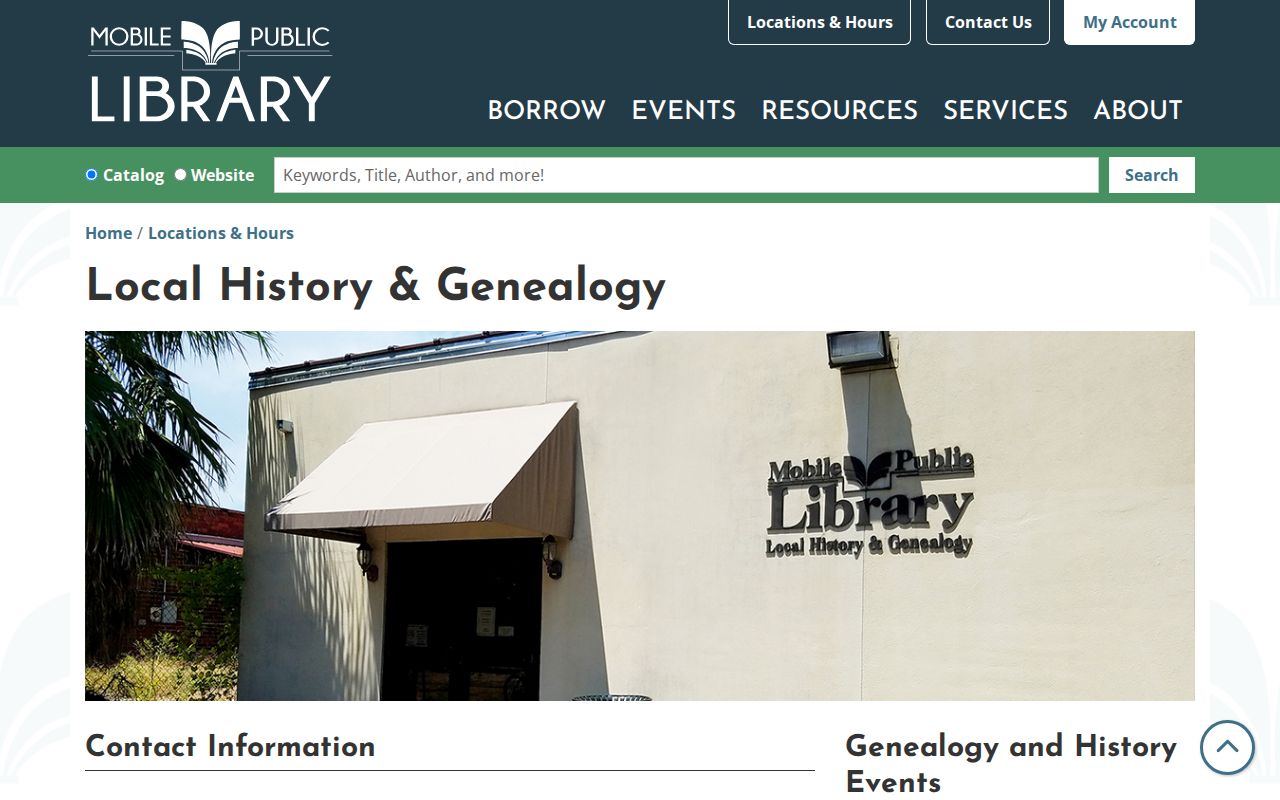
Mobile's shelf is especially useful when a printed directory needs to be paired with a local newspaper, obituary, or map. The library lists newspaper material from 1819-1922 and an Inner City News archive from 1978-2002, alongside its directory holdings.
Alabama Directory Gaps
Birmingham Public Library's Southern History collection begins with Birmingham directories in 1883. Its page notes missing years 1933, 1936, 1943, and 1945; the missing volumes are a documented quirk, not proof that no directory was published or that a family moved. Selected directories for other Alabama cities are available on microfilm, and fragile originals may be served that way.
The Birmingham Southern History directory page gives the run and its gaps. Birmingham's family files also cover local neighborhoods, churches, civic groups, and people of note, which can add context without turning a directory listing into a complete biography.
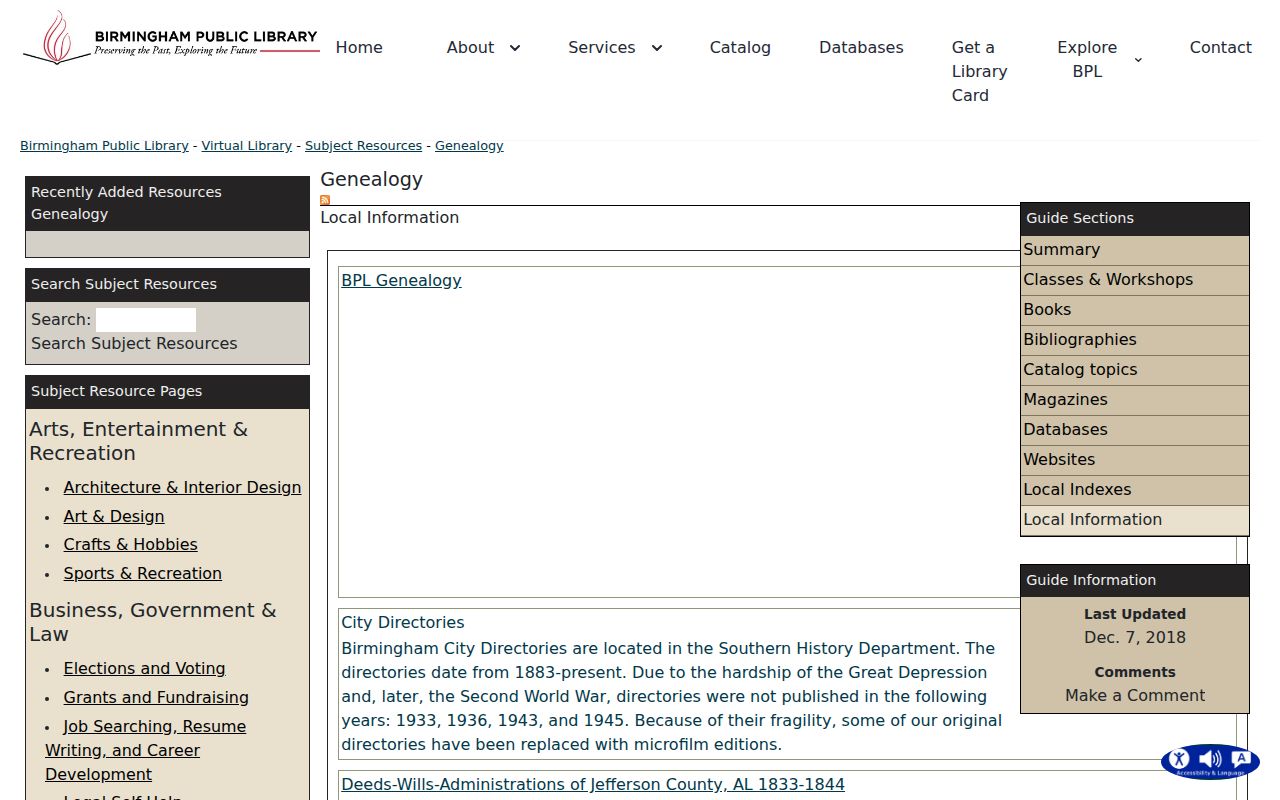
Check whether a volume is a city, suburban, or telephone edition. An edition may cover a wider metro area than the city name on its title page suggests.
Montgomery Directories at ADAH
The Alabama Department of Archives and History finding aid LPR104 documents Montgomery volumes from 1897 through 1957, with gaps and duplicate copies. Examples include runs for 1900-1917, 1919-1923, 1925-1931, 1933-1941, 1942, and 1945-1957. The publisher varies by volume, so use the catalog and title page rather than assuming one company produced the whole span.
The ADAH LPR104 finding aid locates the described material in boxes 103-124 and points researchers to the catalog and Research Room. A finding aid tells what the collection holds; it does not mean each edition is scanned or searchable by name from home. Contact or visit the archives to confirm how a particular volume can be read or copied.
Reading Alabama Directory Entries
A directory entry is a locator, and the publisher decides which details appear. The researched sample inventory below is an expected list of fields to check, based on the collection research; no physical page image was accessible for inspection. It is not a transcription of a photographed Alabama entry, and no mark should be assigned a meaning until the edition's own key is read.
| Name heading | Printed spelling and initials in the alphabetical resident section. |
|---|---|
| Occupation or affiliation | May appear when supplied by that publisher. |
| Street address | House number and street; a separate street guide may reverse the lookup. |
| Household notation | A spouse, widow, boarder, or roomer notation may appear in some editions. |
| Owner or renter mark | Some volumes use a letter such as h or r; confirm the exact key. |
| Phone or business section | Telephone and classified sections may add another listing or business address. |
Compare the entry with its title page, front matter, and address section. A spouse in parentheses, a roomer notation, or a different occupation may help distinguish people with the same name, but those conventions are volume-specific.
Alabama Directory Terms and Keys
Before using an old Alabama directory to infer a household, learn which part of the book is open and what the publisher meant by each mark. The same abbreviation can change between editions. Treat the key and the coverage note as part of the evidence, not as decoration.
- Criss-cross directory
- A directory section arranged by street address so a known place can lead to a printed occupant or subscriber name.
- Householder index
- A name-based entry list that points to the person or household information included by that edition.
- Abbreviation key
- The volume's own guide to shortened words or symbols; read it before interpreting h, r, wid, or similar marks.
- Edition snapshot
- A publication assembled for a particular period; it may lag a move, omit a household member, or use a business address.
A reverse section can help when the address is known and the name is not. The alphabetical section works in the other direction. Some books include both, while others may have only a street guide, phone list, classified pages, or a separate suburb edition.
Trace an Alabama Directory Household
For family history, follow the same person across more than one directory year and keep the edition details with every note. Alabama runs have gaps, and a town may be listed in a suburban book instead of the expected city volume. A name disappearing can mean a move, a death, a changed boundary, an unlisted child or boarder, or a missing edition. Compare nearby years and a second record before choosing among those explanations.
- Find the first likely name entry and copy the exact spelling, address, occupation if printed, and volume year.
- Read the abbreviation key and note whether the volume covers the city, suburbs, or a wider district.
- Check one or two editions before and after it; use a street-order section to test a known address.
- Pair the directory with the nearest available federal census to compare household relationships, age, birthplace, and enumeration geography.
- Follow a dated lead into a newspaper, obituary, cemetery record, deed, probate file, or map held by the relevant library or office.
Federal census records become public under the 72-year release rule, so directory years can help bridge the decades between releases. A census and directory use different collection methods; one is not a correction of the other. When the goal shifts from one historical entry to a current record for one person, the Alabama resident lookup lays out the separate verification route.
Search Alabama's Mobile Digital Archive
Mobile Public Libraries provides a free digital archive with keyword, Boolean, and exact-match search, plus filters for Item, File, Collection, and Exhibit. Advanced search is available for items. Its contents include local histories, maps, death records, yearbooks, manuscripts, and other Mobile collections; the archive is a local-history source, not one statewide directory index.
The Mobile digital archive search page provides live controls and collection types. Use the filters to narrow a result and open its record description to learn the date range and access conditions.
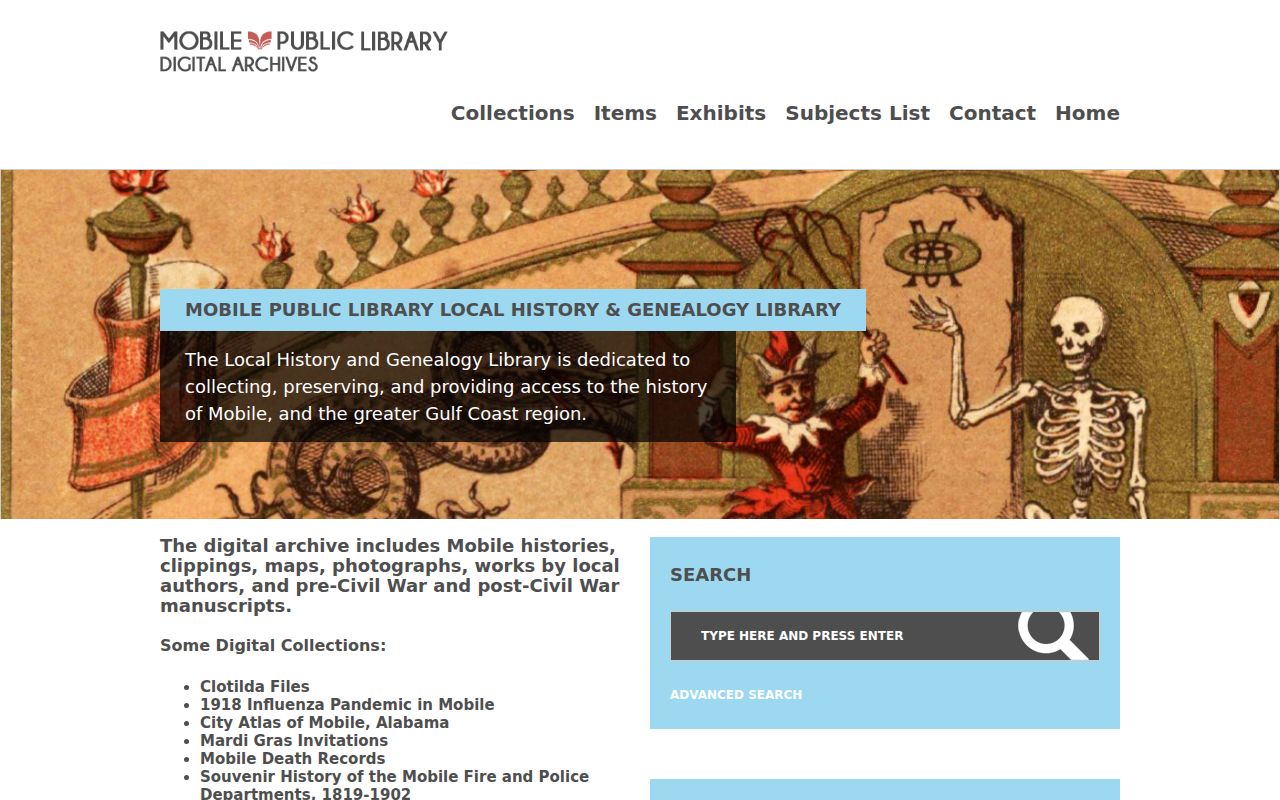
Some results are descriptions of a collection rather than a name-searchable entry. Record the item title and collection details, then check whether the image is online or must be read through the library.
Alabama Archive Access for Directories
ADAH links old directories with wider local-history evidence: county-records microfilm, newspapers, maps, church records, yearbooks, private manuscripts, and research-room databases. Its County Records database lets a researcher search by county and singular record type, such as deed. The record itself may remain at the originating county office, so a catalog result is a route to the record rather than a replacement for it.
ADAH's Research Tips list free onsite access to Ancestry, Fold3, Newspapers.com, and HistoryGeo, and identify ADAH as a FamilySearch affiliate library. These databases and microfilm holdings support family-history work when an online scan is missing. Check the ADAH county-records search for county and record-type controls, then confirm how to consult the reel or originating office volume.
Alabama family-history research may also seek a former classmate, a military friend, or a relative when a current lookup has ended. ADAH and local library holdings provide leads through newspapers, yearbooks, church records, obituaries, and private collections; each source has its own catalog and access rules.
If no online directory scan appears, ask the holding library or archive about the catalog record, box or reel, appointment, copying rules, and whether staff can answer a limited reference question. A local library can also help locate a newspaper reel or a yearbook that fills a gap in the directory run.
Alabama Directory Timeline
The start dates show why no local directory can stand in for the whole state. Mobile, Birmingham, and Montgomery have different collection histories and local shelves. The comparison is useful for choosing where to search, but the documented ranges do not guarantee an unbroken annual run.
| Year or span | Collection milestone | What the date means |
|---|---|---|
| 1837 | Mobile directory holdings begin | Mobile Public Libraries reports directories back to this year. |
| 1883 | Birmingham directory run begins | BPL's Southern History collection begins its Birmingham run. |
| 1897-1957 | Montgomery volumes described in ADAH LPR104 | Documented range with gaps and duplicate copies. |
| 1980-July 2007 | ADAH Birmingham directory volumes | ADAH LPR104 lists these volumes separately from suburban samples dated 1975-1996. |
The comparison reflects a research quirk: a Mobile shelf begins earlier than the documented Birmingham and Montgomery runs, while an ADAH Birmingham holding reaches into a modern period. Verify the exact year and locality in the finding aid or library catalog before planning a search.
For a present-day address question, the Alabama street directory process follows county parcel and deed records. Historical directories answer a different question: what a publisher printed in a specific place and edition.