
Alabama Resident Lookup by Record Type
Alabama does not keep one master list of residents. A useful name search follows separate records, each made for a different task. VoterView can confirm a registration entry and polling details; it does not prove ownership. County property systems identify a parcel owner and tax-mail address, which may differ from the person living there. Court dockets show a party and case history, while vital records confirm events under their own access rules. Start with the most direct source, then use another record to test the match.
| Record | What It Confirms | Where | Access |
|---|---|---|---|
| Property and tax roll | Owner of record, parcel, situs, tax-mail address | County revenue commissioner, routed by ALDOR | County site and office; fields differ |
| Voter registration | Status, residence address, polling place, election detail | Alabama Secretary of State VoterView | Free name and date-of-birth search |
| Trial-court docket | Party, case type, filing, actions, disposition, document links | Just One Look, Alacourt, circuit clerk | Remote search has a fee; clerk viewing is available |
| Vital record | Birth, death, marriage, or divorce event | ADPH or the county office for an older event | Rules depend on record type and date |
| Probate file | Estate, will, executor, heir, or filing role | County probate office or circuit clerk | County-specific index and copy rules |
| Business or license | Entity role or credential status | Secretary of State or the licensing board | Search modes and fields vary |
Choose by the detail already in hand. A full name and birth date point to VoterView; a street address points to the county parcel system; a case number points to the court index. For an older family question, an archive or library may hold the only useful index. Keep the county and date beside each result so a statewide name search does not blend a voter address, tax address, and court party into one unsupported identity claim.
Alabama Voter Records by Name
The free Alabama VoterView search asks for first name, last name, and date of birth. A result may show registration status, residence address, polling place, ballot status, and election detail. The Jefferson County page has an extra election-detail choice after a name search. Its address tool checks a polling location for a typed residential address; it is not a ZIP-wide directory of people. Use the official VoterView lookup for a single record, and keep the search date with the result.
For a broader file, the Secretary of State has a separate voter-list request form. It lets a requester specify a county, city, district, or other available area; choose active, inactive, or both; select fields; and ask for mail, email, or pickup in a stated format. The office quotes the cost before payment. A requested field marked “as available” may not be present in every record or geography. Contact a county Board of Registrars for a correction, using the Secretary of State's county official lookup to find its office. Registration status and participation history do not show a ballot choice or establish current physical presence.
Alabama Court Results for One Person
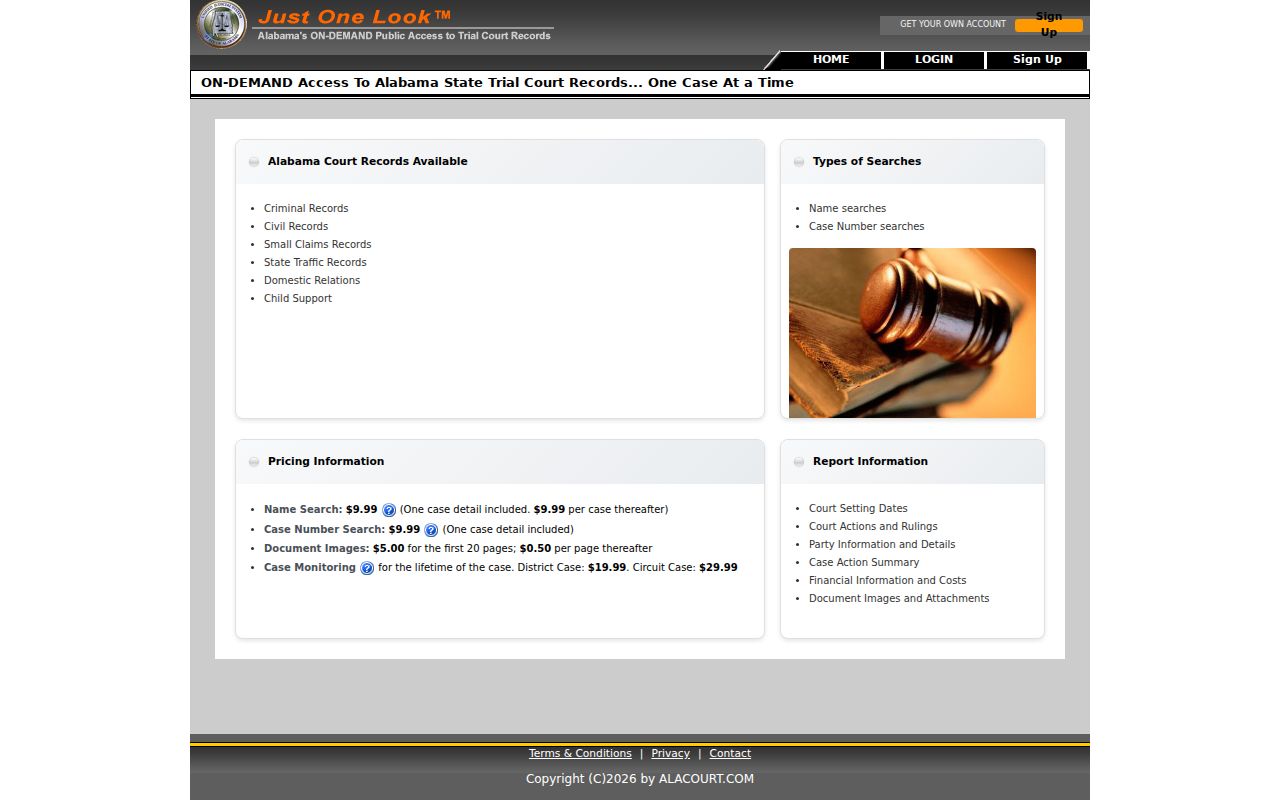
Alacourt's Just One Look offers name and case-number searches for criminal, civil, small-claims, traffic, domestic-relations, and child-support records. The separate Alacourt.com subscriber route serves remote subscriber access. A name search is listed at $9.99 with one case detail included, with $9.99 for each added case. Image access is $5 for the first 20 pages and $0.50 per added page. Check the portal before ordering because charges can change.
This is the captured report inventory, not a sample person's case. A party name is a lead, not proof of identity. Compare county, case type, party role, chronology, and any lawful identifying details that are visible.
| Result field | What the report may show |
|---|---|
| Court setting dates | Dates listed for hearings or settings |
| Party information | Names and roles attached to the case |
| Actions and rulings | Docket events and court decisions |
| Case action summary | A case chronology, not the full pleading file |
| Financial information | Costs and financial entries shown in the report |
| Images and attachments | Linked documents, subject to access rules and image charges |
The screenshot of the official Just One Look page shows the name and case-number entry points and the advertised report options. Use it to understand what the remote search can return, then rely on the clerk for the filed record.
For public electronic dockets and filings, circuit and district clerk offices provide in-person viewing during regular business hours without a remote subscription under the court access rule. A clerk may charge for copies, and mail requesters pay postage. A case absent online may still require a clerk search. Municipal cases go to the municipal clerk; federal matters go through PACER and the relevant federal clerk. Alabama state and federal indexes do not cover each other's cases.
Alabama Vital Record Access Windows
The Alabama Department of Public Health Center for Health Statistics files statewide birth and death records from 1908. Access depends on the event and how long ago it occurred. Birth records are restricted for 125 years; death records for 25 years. During a restricted period, only the person or an authorized relation or representative may apply. Marriage certificates from August 1936 onward and divorce certificates from 1950 onward are nonrestricted. Older marriage details belong to the probate office that issued the license, while older divorce records are with the county circuit court.
| Record | Alabama Coverage | Access Rule | First Step |
|---|---|---|---|
| Birth | 1908 to present | Restricted for 125 years | ADPH; eligible applicant and ID |
| Death | 1908 to present | Restricted for 25 years | ADPH; eligibility depends on age of record |
| Marriage | August 1936 to present statewide | Nonrestricted; older licenses are county records | ADPH or issuing probate office |
| Divorce | 1950 to present statewide | Nonrestricted certificate; earlier file is local | ADPH or county circuit court |
Many county health departments issue certificates, often while the applicant waits, but a difficult or restricted search can take longer. Mail requests to the Center for Health Statistics in Montgomery generally take about 7 to 10 days. Online and phone orders use VitalChek and add fees; the Center's direct number is (334) 206-5418, Monday through Friday, 8 a.m. to 4:30 p.m. Central time except state holidays. The first search and copy generally costs $15, and each added copy in the same order costs $6. Birth orders may add a $15 expedite fee. Check the current form and instructions before sending a request, and do not send cash.
Use the state's vital records page and its HS-14 application to confirm the current route and eligibility; the HS-95 guide lists identification options for restricted records. A public index or family clue is not the same as a certified certificate, and a closed event should be pursued through the lawful county, probate, court, or adoption process that applies.
Alabama Business and License Cross-Checks
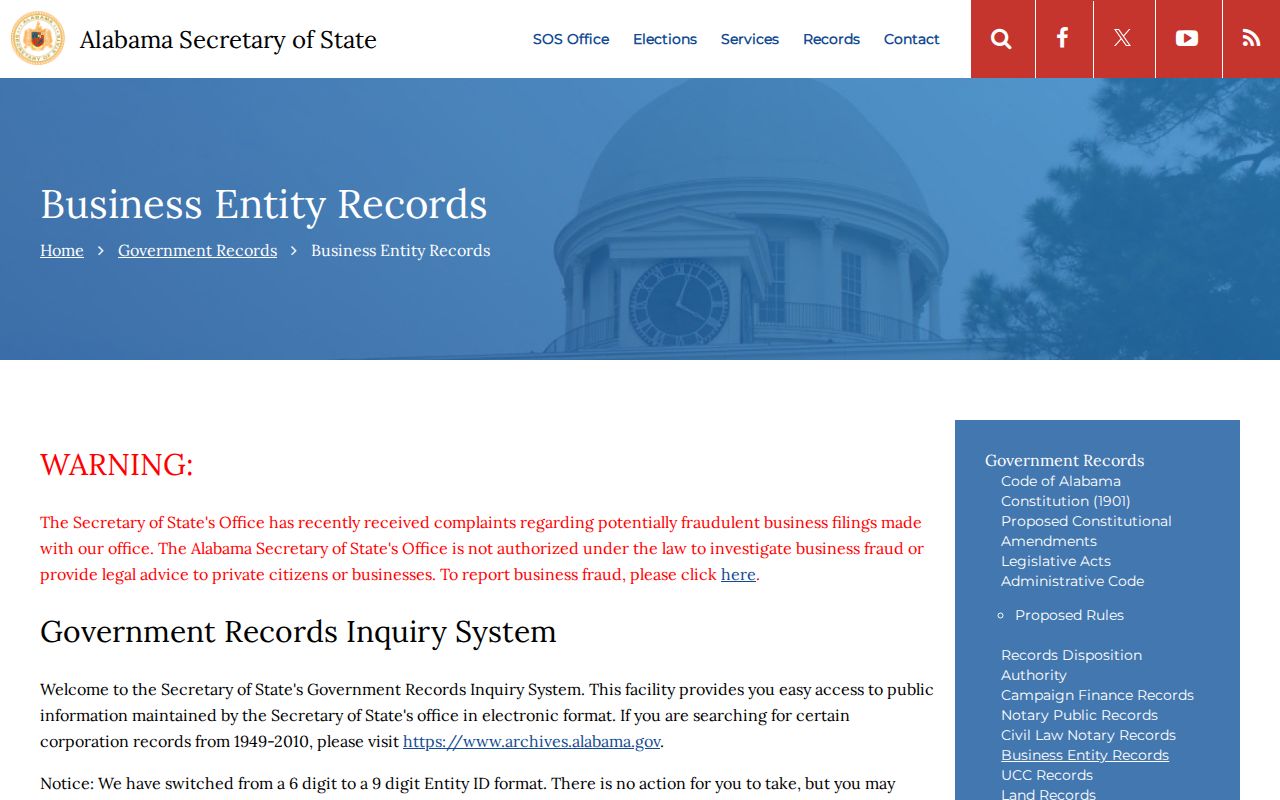
The Alabama Secretary of State's Government Records Inquiry System has four business modes: Entity Name, Entity Number, Officer | Agent | Incorporator, and Reservation | Registration by ID. A filing can show the entity's name and ID, status, formation date, registered agent, principal or mailing address, officers or organizers, and linked documents where supplied. Try a person's role search as well as an entity name, and copy the entity number before opening a filing. The role on a filing describes what was recorded; an agent, organizer, officer, and owner are not interchangeable labels.
Old corporate records have a separate historical path: the Secretary of State directs some 1949 to 2010 materials to the Alabama Department of Archives and History. Local assumed-name and city business-license records depend on the county or municipality. For a professional credential, use the board that issued it. The Board of Nursing lookup can show name, number, type, status, dates, and encumbrance history; the Real Estate Commission provides its own status check.
The Secretary of State business-record page shows the official search choices. This screenshot is a reference for choosing a search mode, not a sample identity result.
Capture the entity ID, filing date, and stated role when using a business record as an identity cross-check. If the filing points to a different county or an older address, follow that office's record rather than treating the business address as a home address.
Alabama Custody and Registry Limits
Some searches answer narrow questions and should stay in that lane. The Alabama Department of Corrections search covers people currently incarcerated in state custody; its form accepts an AIS number or name and includes race, sex, birth year, and institution fields. It does not provide historical inmate data online. The ALEA registry search has last-name, type, status, city, and state fields. Its posting rules and exclusions mean it is not a full list of residents or a general identity file.
The ADOC search form makes its current-custody scope visible, while the ALEA search page shows its registry filters. Each screenshot documents the official controls; neither changes the need to confirm a name and date with the agency that holds the underlying record.
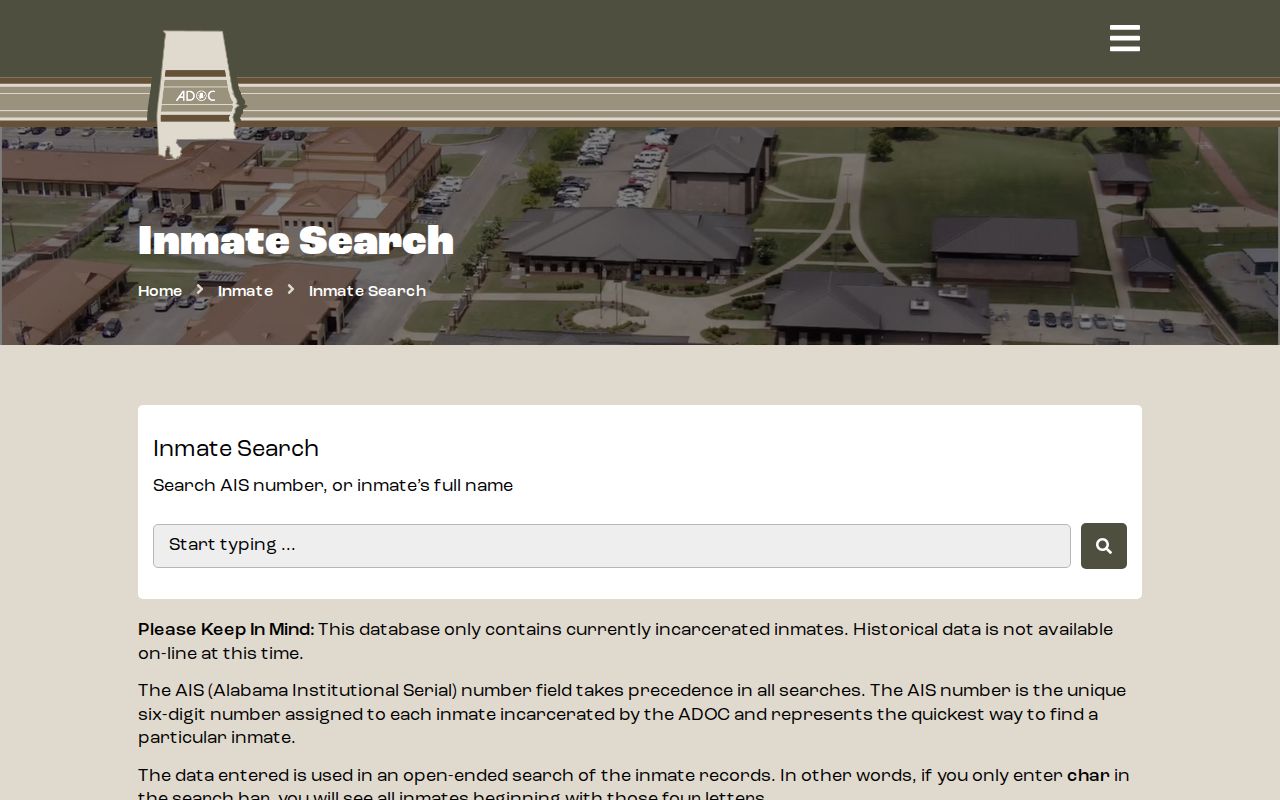
This form can help answer a current custody question, but it is not a general address record and has no online historical inmate data.
A registry page may be updated after a local law-enforcement review, so it should not be described as a live guarantee of an address. Contact the appropriate agency about a correction or report. The ALEA registry guidance explains the public scope and reporting rules.
The official ALEA search page shows the registry filters available to the public.
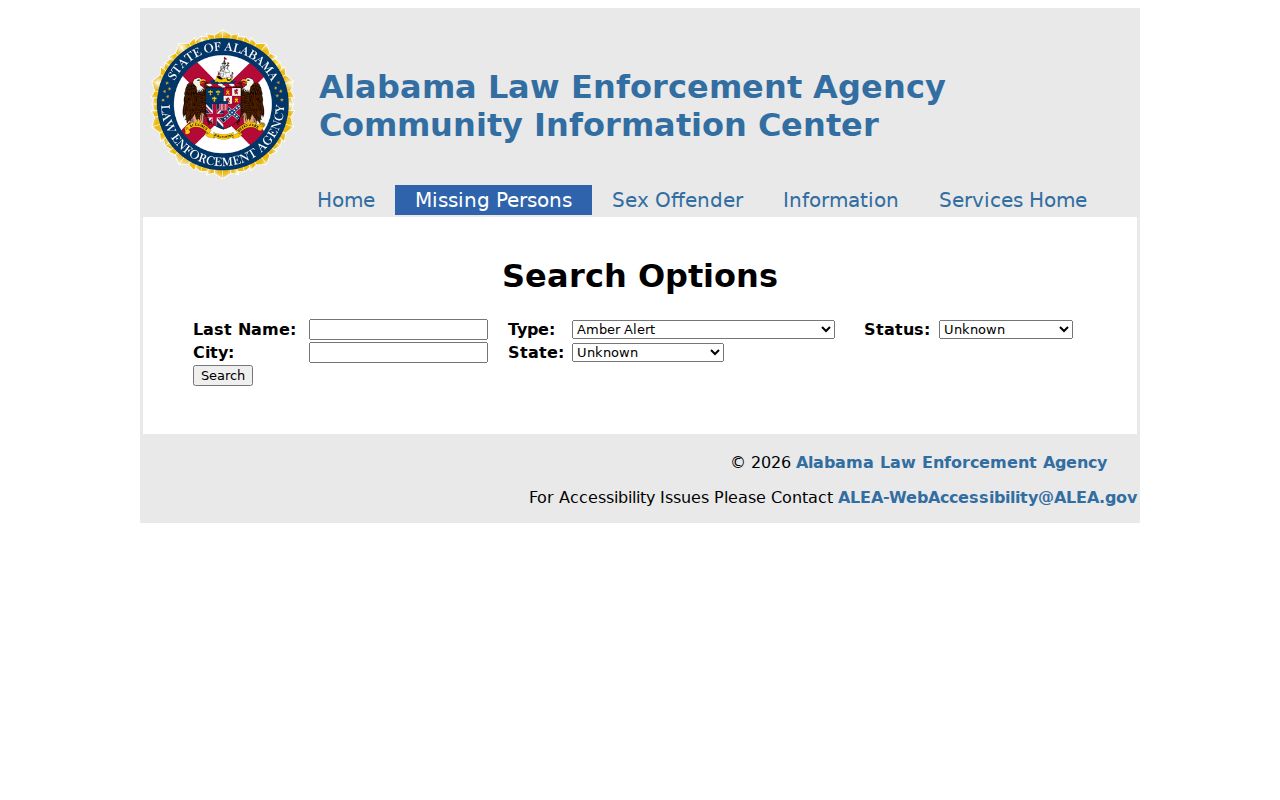
The visible filters narrow the registry search but do not turn it into a full resident list or prove that an entry is current at the moment it is viewed.
Alabama Heir and Family Record Trails
For an heir question, county probate records can connect a name to a will, estate, executor, petition, or inventory. Begin with the county where the estate was filed, then ask the probate office or circuit clerk how its index and file access work. A probate result can clarify a family role, but a name in a petition still needs support from dates, addresses, and other records. If the file is not online, the courthouse counter or a written request may be the next step.
A birth parent search has a separate route. Public birth-record rules do not open sealed adoption records. Contact Alabama ADPH and the court or agency responsible for the adoption to ask about the official registry and confidential-intermediary process. For a former classmate, look to yearbooks, alumni offices, directories, and local newspaper collections; these can provide a dated lead without exposing a protected government record.
The Alabama Department of Archives and History supports this human use when a modern search ends. Its Research Room, catalog, county-records microfilm, newspapers, maps, church material, and private collections can help with heirs, classmates, military ties, family history, and past residents. The county microfilm search routes by county and singular record type. A catalog entry may identify a collection without making every page searchable online, so ask for its title, date span, and access terms.
Verifying an Alabama Resident Record
Use a repeatable check before treating two entries as one person. Start with the name form you have, note the county, and keep the date of each search. An address needs a label: voter residence, parcel situs, tax-mail address, and business mailing address can all differ. The county property search is routed through the ALDOR county directory; Alabama has no single statewide parcel portal, and search fields vary by county.
- Write down the full name, middle name or initial, suffix, maiden or former name, likely county, and any known time period.
- Search VoterView or the county property system for a lead, then record whether the address is a residence, situs, or tax-mail field.
- Search the court, vital, business, or license source that fits the question; compare county, dates, party role, spouse or parent, and parcel or case number.
- Ask the custodian for the filed record or correction process when a result matters, and retain its document number and search date.
Two independent anchors reduce same-name errors. A county plus a birth year may help; so can an address paired with a spouse, parcel, or court role. Do not force a match when those details conflict. Keep both records separate and note what is unresolved.
- Docket
- A court's dated list of filings and actions in a case.
- Index and image
- An index points to a record; an image is a view of the filed page and may require a separate fee or clerk request.
- Certified copy
- A copy marked by its custodian as an official copy, requested from the office authorized to issue it.
A negative search is useful if its limits are clear. Save the exact spelling, variants, county, date, and coverage note, so no one mistakes an index gap for proof that no record exists.
When Alabama Record Searches Stop
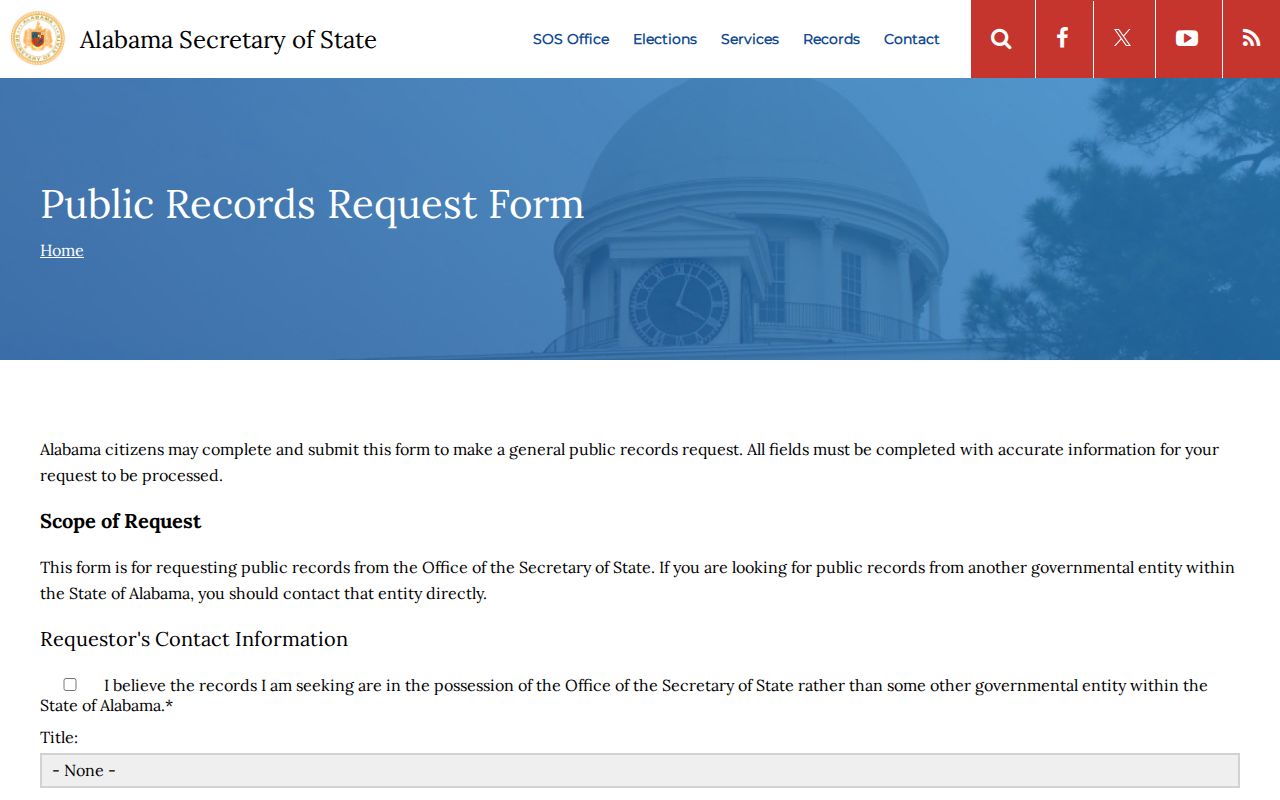
When a web index ends, identify the actual custodian before asking for more. Alabama's Open Records Law is a starting point for public writings, but each office has exceptions and separate procedures. The Secretary of State's policy explains that its form is for its own records and asks for a narrow description, contact details, identification and Alabama-citizen information, delivery choice, signature, and fee authorization. Voter records have a separate list request route, so use that form for that purpose.
The Secretary of State's public-record request form shows the fields needed for that office. Its screenshot helps distinguish an agency request from a broad name search. For court files, contact the circuit clerk; for certificates, ADPH or the proper county office; for parcel and deed questions, the county revenue commissioner or probate judge. A clear request gives the office a date range, record type, name or number, county, and any known file reference.
For older records, ADAH offers county microfilm, Research Room access, and a research-request service. The form accepts one surname and up to four source choices, with up to 20 pages included; the listed fee is $15 for Alabama residents and $25 for out-of-state requesters, with a two-to-three-week estimate and payment due even if the search is negative. County libraries can also hold newspapers, directories, yearbooks, and microfilm that no state name search indexes. A phone call can establish custody and request steps, but staff may not confirm protected facts by phone.
Alabama Resident Record Privacy Limits
A statewide public-record rule does not make every field open. Alabama court privacy rules protect full Social Security and financial-account numbers, full birth dates, and other identifiers; sealed, juvenile, and protected family records may be absent or redacted. SOS voter affirmations let qualifying domestic-violence victims or guardians and certain public officials limit public voter fields to the person's name, as described on the registration page. Driver records have federal privacy limits, and library circulation records are exempt under Alabama's open-records law.
Alabama's reviewed official sources did not show a general substitute-address program or broad deletion right. If a record is wrong, stale, or belongs to someone else, contact the office that keeps it: the Board of Registrars for voter data, a court for a filing, the revenue commissioner or probate office for property, and the issuing board for a license. Commercial profiles have their own opt-out steps, but removing a profile does not change the government source it copied. A public entry is a reason to verify, not a license to publish protected details or pursue someone.
The Secretary of State's AVID update explains Act 2025-424, which moves list-maintenance identification to Alabama's Voter Integrity Database rather than ERIC. The system uses ALEA, USPS address-change, death, and interstate information. An older voter list and a current lookup can differ as records are updated; use the county Board of Registrars to ask about a correction.
Lawful personal use. Use public records for a specific, lawful purpose such as family research, reconnecting, or checking a record tied to a known event. Do not stalk, threaten, harass, or expose a protected person's location.