
Alabama Previous Residents Across the Eras
Alabama has no single deed index that reaches every county and period. County probate offices hold most post-1950 deeds, while the Secretary of State land search gives an earlier statewide path. Libraries and archives add address-to-person evidence, but their volumes have gaps and cover different places. Choose a source by date, then verify the county and parcel before treating a name as part of the same history.
| Source | Years It Covers | Where Held | What It Shows |
|---|---|---|---|
| County deed and probate index | Post-1950 generally county-held; online cutoff varies | County probate office or county portal | Parties, instruments, dates, legal descriptions, and prior deed references |
| Secretary of State Land Records | Statehood through 1950 | Alabama Secretary of State | Historical state land entries searchable by name, township/range/section, or book |
| ADAH county microfilm | Some series predate statehood; latest generally from the 1950s | Alabama Department of Archives and History and originating office | Selected deeds, wills, estates, marriages, and other county series |
| Mobile directories | Local run reaches back to 1837 | Mobile Public Libraries Local History and Genealogy | People, addresses, businesses, and phone listings by edition |
| Birmingham directories | BPL run begins in 1883; ADAH holdings include later urban and suburban volumes | Birmingham Public Library and ADAH | Resident and street-guide entries for the places covered |
| Montgomery directories | 1897-1957 documented at ADAH, with gaps | ADAH LPR104 finding aid and boxes | Names, addresses, occupations, and changes between editions |
| Federal census | Schedules released under the 72-year rule | Federal archives and participating libraries | Household relationships and the enumerated place at a census date |
| Sanborn maps | Selected cities and years | Library of Congress, ADAH, or local libraries | Building footprint, use, materials, and street context |
| Building permits | City-specific; no statewide index located | Municipal building or planning office | Construction and alteration records tied to a local address |
| Obituary and probate records | Newspaper and estate date-specific | Newspapers, libraries, county probate office, or court | Death, relatives, executor or heirs, and a last known address |
The table separates owners from occupants. A deed documents a transfer of legal interest, not every person who lived at the property. A directory can connect a person with an address for one publication period, but may omit households or use a wider metropolitan boundary. For a solid Alabama address history, pair at least two kinds of evidence and keep the source, date, and place with each note.
Trace Alabama Previous Residents Through Deeds
Start from the present parcel. The Alabama Department of Revenue's county property directory routes to each revenue commissioner or assessor and any parcel search. The Secretary of State's county official lookup helps identify the probate office and its public contact route. Both are routing pages, not parcel databases.
Alabama deeds are filed through county probate offices. Search by parcel and legal description as well as owner, since an index may use an estate, trust, business, or prior owner's name. Continue only when the land description still matches.
- Copy the parcel number, owner, situs and mailing addresses, and legal description from the current county property record.
- Search the county deed index for the owner's purchase as grantee, the party receiving the deed.
- Note the date, instrument or book/page number, grantor, grantee, and prior instrument reference.
- Search that grantor as grantee, matching the legal description and lot or tract.
- At the online cutoff, check county books, the probate counter, or archival microfilm.
- Grantor and grantee
- The grantor transfers an interest; the grantee receives it.
- Chain of title
- The linked record of transfers for a parcel, followed from one owner to the prior owner.
- Legal description
- The formal land description, such as a lot and block or metes-and-bounds calls. It can identify the same land when street names or numbers change.
Note: A deed match must follow the land description, since a shared name alone does not establish the same parcel.
Alabama Previous Residents in SOS Land Search
The Secretary of State's Land Records search is the unusual statewide link in an otherwise county-based chain. Its described span runs from statehood through 1950, with search modes for name, township/range/section, and book. The office directs researchers to the county Probate Judge for records after 1950. Search results may help locate an older transaction, but the underlying county record remains important for confirmation.
The Alabama Secretary of State land-records page shows those search routes and the handoff to county offices.
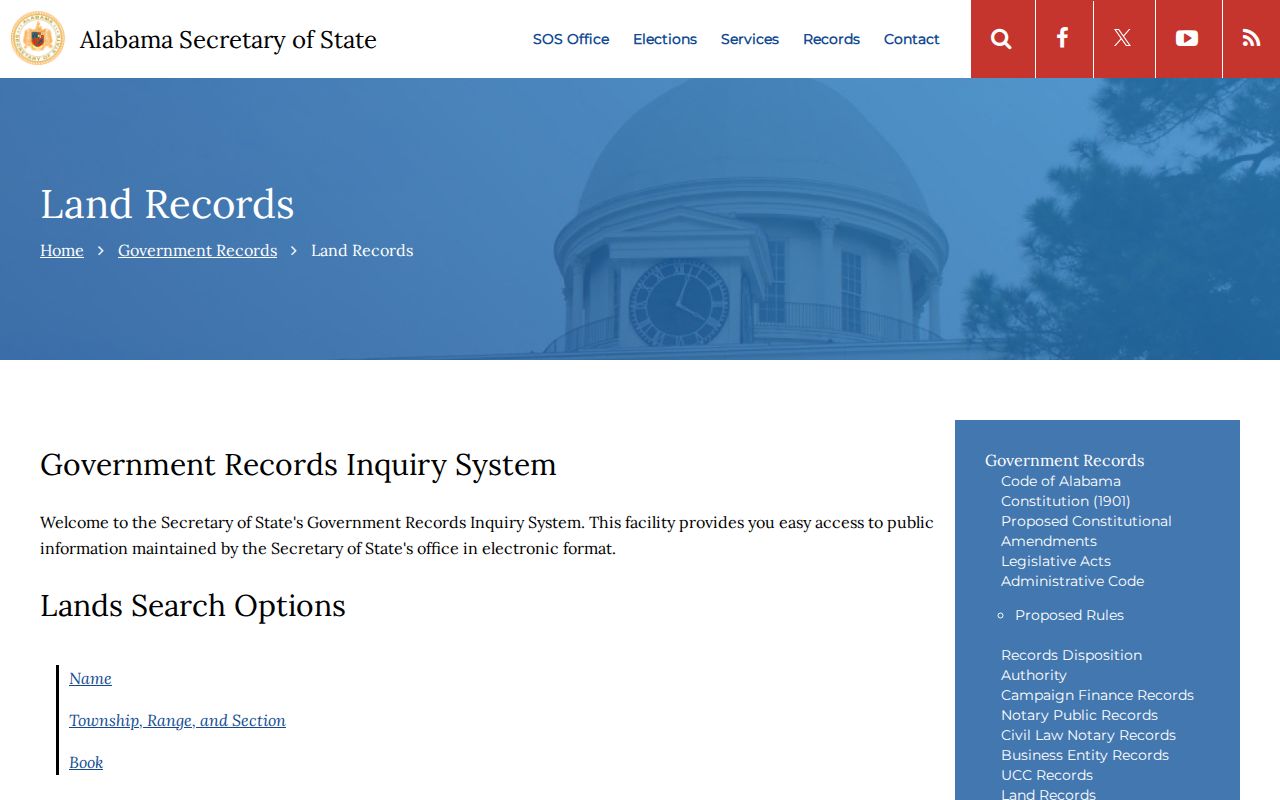
The screen documents a historical search path; it does not establish a statewide index for post-1950 deeds or replace the county probate office.
When Alabama Deed Indexes End
Alabama county online indexes vary in start year, image access, and fees, so confirm the exact cutoff with the relevant probate office. When a search ends, ask by phone or at the counter about deed books, a public terminal, mail or email copies, and any local portal. A public-record request cannot make a county create or compile a record it does not keep.
The ADAH County Records database locates microfilmed local and county series. Search a singular type such as “deed,” note the county and years, then confirm where the original is held. The ADAH county microfilm locator represents a record series, not a resident record itself.
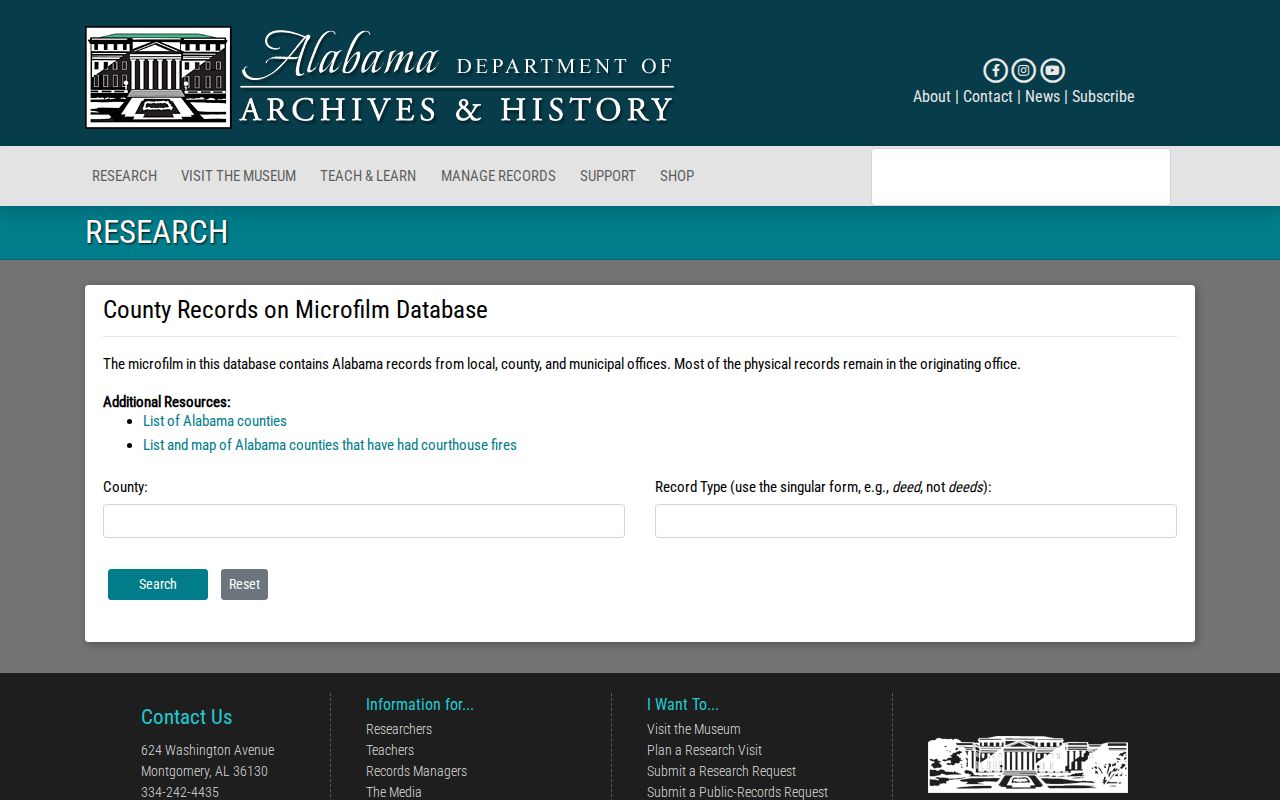
After finding a series, follow the originating office's rules for an image or certified copy. County counters, local libraries, historical societies, microfilm, and archive-affiliated library access are also documented routes. ADAH research requests cost $15 for Alabama residents and $25 for out-of-state residents. One request can cover one surname and up to four sources, includes up to 20 pages, and usually takes two to three weeks. The ADAH request page gives current terms.
Note: A county's online start year may differ from the first year of its surviving deed books and other record series.
Pair Alabama Previous Residents with Census Years
Directories and censuses answer different questions. A directory is a dated snapshot with address, name, and sometimes occupation or household cues. Released census schedules add household relationships, age, birthplace, and enumeration geography. Neither source is a full list of everyone at one parcel. Build a chronology from a known street or household name; check the title page, publisher, place covered, street guide, and abbreviation key, then compare the closest released census. The Alabama city directory page describes the collections, while a past-address search uses each edition as one line of evidence.
The state-level review did not verify a photographed directory entry. Spouse cues, resident marks, and occupation details depend on the actual volume and its key.
- Copy the original street spelling and number from the deed, map, family note, or prior address record.
- Check the directory's front matter for city and suburban coverage, then use its street guide or address section.
- Write down the visible name, address, spouse or household cue, occupation, and the edition's own abbreviations.
- Compare a nearby directory year with the closest released census, keeping their dates and address conventions distinct.
- Test the address and household against a deed, obituary, probate file, map, or newspaper before drawing a conclusion.
A missing edition is a gap in the record, not proof that a household left. Metropolitan volumes can include suburbs, while a local edition may omit rural routes or areas beyond its stated boundary.
Note: A directory's publication year can lag when its names and addresses were gathered for that printed volume.
Alabama Previous Residents and Street Changes
There is no statewide address-renumbering index. Old directories may use a rural route, former street name, or number set before annexation. Carry the legal description, lot and block, and subdivision name alongside the modern parcel address.
Selected Sanborn maps show a building footprint, use, materials, and nearby structures for some cities and years. The Library of Congress maps gateway and ADAH's collections help locate historic sheets, but coverage is selective. A plat or deed may connect an older land description to a modern parcel when the street label has changed.
Alabama has no statewide permit or code-case portal. If the municipality is known, ask its planning or building office whether it can search older files by parcel, address variant, permit number, or owner. A permit can help date construction or alteration, but does not identify who lived there.
Alabama's Uneven Directory Volumes
Alabama's printed record varies by city and year. Mobile Public Libraries documents local directories reaching back to 1837. Birmingham Public Library's run begins in 1883 and notes missing years including 1933, 1936, 1943, and 1945. ADAH's Montgomery finding aid documents volumes from 1897 through 1957, with gaps and duplicate copies. These are collection starts, not proof that every year or neighborhood appears.
This difference matters when choosing a search path: a longer local run may help with an older address, while a missing volume can make a household look absent for a year. Mobile's Local History and Genealogy collection and Birmingham's Southern History directory resources document separate local shelves. The printed title, publisher, city boundary, and exact edition should be checked before comparing names across towns.
Past Alabama Households and Family Trails
A deed chain can end at an estate or at a person whose family moved away. Probate files may identify a petitioner, executor, heirs, inventory, sale, or final settlement. An obituary can add a death date and family link, while cemetery indexes, newspaper notices, church registers, yearbooks, and local history files can add context that a land record does not contain. ADAH and local libraries provide research routes for some of these materials; coverage remains collection-specific.
For an heir search, former-classmate reunion, or family-history project, give an archive the county, known name variants, parcel or legal description, and the date range you can support. ADAH's county microfilm catalog, research room, and affiliated-library access can bridge a gap, but a catalog entry is not a guarantee that a named person appears in the record. Compare each new name with a second dated source and record whether it refers to an owner, household member, or relative.
House-history use. Keep research to lawful personal and family history. A public address is not permission to follow, threaten, expose, or repeatedly contact a living person.
Alabama Previous Residents and Deed Safety
Title history deserves a direct check with the county custodian, especially when a result is used to respond to an unexpected sale notice or document. Alabama's Property Protection Act is scheduled to take effect October 1, 2026. At the September 2026 research review, the Alabama Securities Commission said its processes and forms were still being developed. The act addresses seller-impersonation and title-fraud concerns, but it does not turn a third-party notice into proof of a transfer.
Compare the deed's recording details and legal description with the parcel, and contact the county probate office through an official state or county directory if something does not match. The Alabama Securities Commission's Property Protection Act information is the current state route for updates. An index hit is a lead; the recorded instrument and the custodian's confirmation carry the evidence.